

Whenever I’m asked about my priority in teaching students at IslandWood, my answer is always stewardship. I want my students to walk away from their week in the woods with me with a greater sense of respect and care for themselves, their human community, and their natural community. I want them to go home feeling inspired to continue on their own personal path to stewardship. Yet, I’m certain that the majority of 4th-6th graders in the world aren’t going to run home and excitedly tell their friends and family all about how they were a steward at IslandWood, when that has to compete with their memories of team-building, visiting treehouses, or doing a solo walk. Of course, thinking back to their closing field day at IslandWood, these students could have all told me how any of those favorite activities or moments were part of stewardship, or taught them about stewardship, but it’s not their priority. How can I make this big idea of stewardship, which is a word that many of these kids have never heard before, something that students are motivated to learn about and do, both at IslandWood and beyond?
Little did I know, the answer to this question would lie in a short segment of our Advanced Instructional Strategies class devoted to a brand new concept to me: social marketing. We soon realized that many little IslandWood traditions were rooted in this idea, and I was inspired to come up with my own methods – it seemed like the perfect way to get kids excited about being stewards. Thus, I developed a social marketing plan to get my 4th-6th grade students more motivated to learn about stewardship and act as stewards.
This concept feels like a perfect fit for social marketing. Ultimately, stewardship is a set of habits, and I can only hope to plant a seed for those habits while I have a group of students. The biggest barrier to students acting as stewards is just encouraging that extra thought involved in making decisions, and the extra effort involved in pushing past one’s comfort zone or trying to be a better community member. My goal with this social marketing plan is to incentivize stewardship to the point that students will begin to get used to the extra “work” involved while they are at IslandWood, and by the time they get home the habit will have already started to form.
Ultimately, I want my students to understand the four pillars of stewardship – what they mean, why they are important, etc. – and to feel motivated to develop better habits in each of them. Many kids’ programs utilize badges to incentivize behavior, and I think
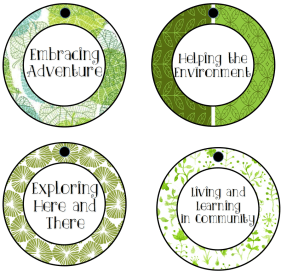
that would be an effective method to encourage stewardship at IslandWood as well. I created a set of badges that will be given out on students’ final day at IslandWood, as a keepsake to remind them of being a steward as well as to recognize a particular pillar within which they excelled. Part of the final activities on Thursday will be an “awards ceremony” in which the students receive their badge, for the pillar they exemplified. Students will hear evidence for why that pillar was chosen for them as well, further encouraging future action. Throughout the week, I will mention this opportunity and encourage students to reflect on the pillars thus far. We will continue ending our days with reflection on these pillars – how we are growing, where we could improve, setting goals, etc., but with the added piece that there will be an award coming for them. The important part here is that every student receives an award. When receiving the award, I will have the students give an acceptance speech, in which they give a gratitude to their community, provide one example of how they will continue to grow in this pillar at home, and one reason that the pillar they’ve exemplified is important. This way, they all associate a positive memory with being a good steward, further encouraging future action. I am excited to try this out in the field this week!
Outcomes:
Knowledgeable Practitioner/Experiential Educator: I utilized what I have learned about social marketing and instruction to create an experience that would drive students to act as stewards of their communities and environment.

 Julia Tandy Harnick
I like where you are going with a behavior that is always in need of extra support. The badges seem like they just might be enough to motivate, too. Works for scouting, after all. One problem I see is that if the students are in part motivated by status that they receive by getting a badge, waiting until the last day will not be that helpful. Consider handing out one a day, and you have time to build motivation for the student who isn’t that much into it on Monday.
LikeLike