
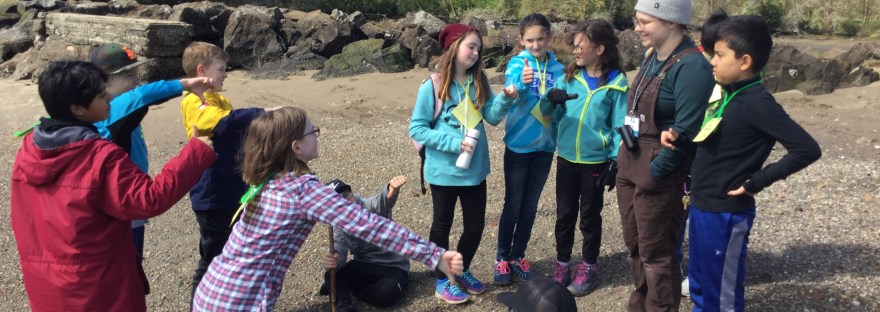
Recently, I’ve been focusing on incorporating the four pillars of stewardship more effectively in my instruction. I have been playing around with the ways that I introduce stewardship as a concept. For a few weeks, I’ve been introducing stewardship first thing Tuesday morning, spending about an hour diving deep into the concept. As a group, we develop a working definition of stewardship, discuss the meanings of these pillars along with activities they could do that fall within them, and set goals based on these ideas. I then plan each of the two full field days with two “focus pillars” each day, which I share with them in the morning. I ultimately want them to be thinking about the pillars throughout each activity. In debriefs, I ask them why they think we did that activity that day, or how it fulfilled one of our pillars. This has helped students to make these more concrete connections both with what they’ve done at IslandWood and what they can do at home.
A couple of months ago, I had a great moment with a student where I saw the wheels turning for the pillars of stewardship. We were on the Teams Course (Whale Watch to be specific) working through the challenge. The day had been focused on Embracing Adventure and Living & Learning in Community, hence the team building. We had done an investigation in the morning and played some games around team communication (Tank & Operator and the Land of Yes) in the afternoon before heading to the Teams Course. We were about halfway through completing our task, and students had paused to restrategize – at this point, they had begun listening to more voices, changing the way they phrased advice (“what if…” vs. “you should…” or commands). Language had shifted to being more supportive throughout the team. As they got closer to completing the task, a moment of silence occurred when all the students were deeply focused. In this moment, one student got a look on his face like a lightbulb had gone off — his mouth was hanging open and his eyes were wide. He excitedly exclaimed to the group, “Living and learning in community!” I was so excited to see this student making this connection I had been trying to encourage all week without having been prompted to do so. In the other activities from the day, students had been successfully making connections with the pillars when asked to do so, but not having conversations about them without my prompting. Seeing this student make this connection completely organically was amazing. I felt like I had been successful in teaching the pillars in a way that stuck with the students. They continued to fully embrace the four pillars throughout the week.
This moment led me to shift the way I evaluate whether or not learning has occurred. If a student can only make a connection after I have prompted them to do so with a question, have they really learned it? If their answers are dependent on me asking the right questions, then does the connection go deeply enough to transfer back home? Seeing students make connections that are totally unprompted indicates to me that they are beginning to ask themselves these questions. They no longer depend on me to prompt them into this deeper thought process if I can scaffold this process throughout the week. While I feel like these new methods have improved student learning and transfer, my next goal is to take it to the next level – I want them to understand more about why stewardship is important. This week, I tried asking students to explain, “So what?” after doing an activity within a specific pillar. I know my students can now see when they are being stewards in various ways, but do they know why they are being stewards? Do they walk away thinking that they should continue these practices of stewardship? And do I encourage stewardship without coercing my students into my specific definition of it? These are the questions I will use to inform the next steps of my teaching.

 Julia Tandy Harnick