
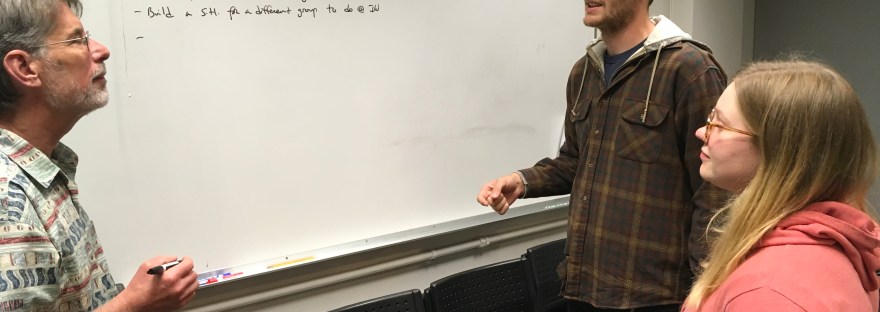
This spring, I’ve been in a class called Collaborative Projects in Educational Leadership: Nonformal Education. This class has been a unique experience for many reasons, not least of which being the experience of collaborative lesson planning. For the second half of the course, we’ve been workshopping lessons together as a class. An individual will bring a lesson they’ve written to some degree–maybe it’s one they’ve tried with students several times, or perhaps it’s just an idea that has yet to be fully fleshed out.
I decided to bring in one of the latter types of lesson, one that I had been toying with but had never really gotten around to planning. It was a scavenger hunt, meant to take place Monday afternoon as we meet a new field group. I wanted to find something high energy and engaging that would keep my students active & on task in a way that they could be successful, since Monday afternoon’s strange level of energy can sometimes be an obstacle to getting students to really focus on an activity. I wanted students to begin to get to know me, their field group, and IslandWood in a fun and energetic way while also accomplishing some normal first day goals, like answering questions in journals or completing a team building challenge. I brought this idea to my class, and they spent around 20 minutes in small groups coming up with ideas to bring this lesson to life.

One group focused on writing clues to get to specific locations on main campus, another focused on activities that could be connected to these clues and the locations at which they could take place, one focused on logistics (how to keep every student engaged, group sizes, chaperone role, etc.), and the last group discussed potential extensions and connections to other lessons in the week.
This was an eye-opening experience for me on the power of collaborative thinking. In 20 minutes, my lesson had gone from a pipedream to something realistic and doable. I had a list of extensions that I would not have thought of on my own, clues for most of the locations on campus, ideas for activities that I hadn’t come up with, and logistical considerations that hadn’t crossed my mind. Yet it all still fit the essence of my original plan.
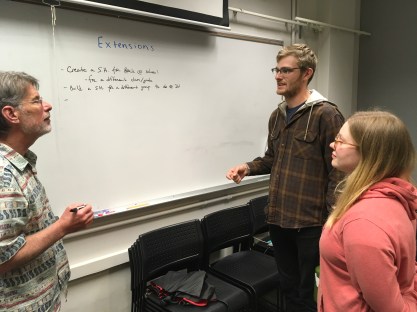
In this experience, I was also in an interesting position of being an facilitator for adults, rather than children – not what I would think of as in my wheelhouse. When introducing the lesson, explaining the small group workshop time, and regathering to share back at the end, I actually ended up using a lot of the same strategies I use when teaching kids, and everything felt fine. I realized that facilitating adult learning is not always that different, and is certainly approachable.
Outcomes:
Servant Leader: I collaborated with peers to create the most inclusive and successful learning experience possible around this activity idea.
Knowledgeable Practitioner: I used what I have learned about lesson design and working with adult learners to guide my workshop.

 Julia Tandy Harnick