
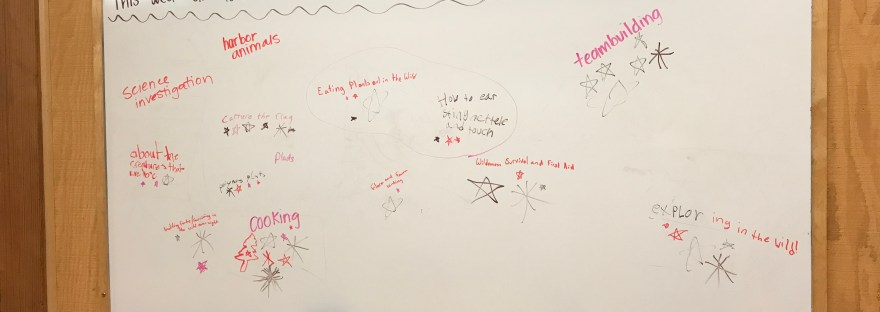
This past week, I decided I wanted to see what would happen if I gave the students the reins for the week, letting them tell me what they most wanted to learn about and then taking the planning from there. When the students arrived Monday, one of the first things we did was head into a classroom with a whiteboard for them to cover with their ideas.
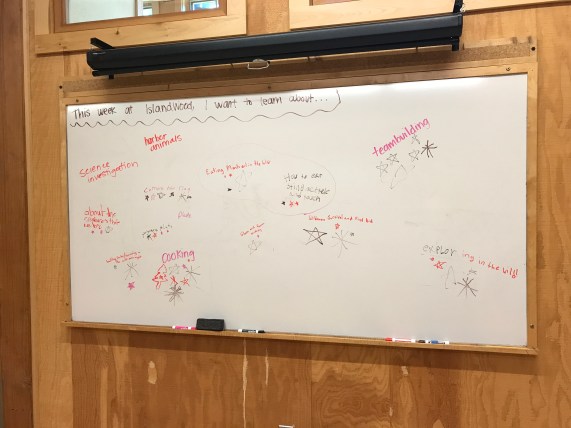
The students struggled at first with my prompt. I added a caveat that their submissions needed to be realistic and fit their teachers’ goals for their time at IslandWood, trying to encourage them away from filling the board with things like “sports” and “video games” and instead to think about why the IslandWood experience could be important. I told the students to read their peers’ ideas, and if they agreed with one that was already on the board, to add a star to indicate another vote. At the end of the brainstorming session, the clear winners were teambuilding, wild edibles/cooking, and learning about the plants and animals of IslandWood. From here, I decided to make the theme for the week community, with focuses in ethnobotany and ecosystems.

On Tuesday, we were began our day with an Each One Teach One focused on ethnobotany. The students learned about cultural connections with plants on campus, and answered questions in their journals about the plants’ relationships with humans. After lunch, we had an entire afternoon scheduled with Melinda West, an artist in residence with a focus on natural weaving — a perfect fit with the rest of our day. We debriefed our day with a discussion on what we learned and why it was important. Students were engaged and making connections between the activities of the day.
Wednesday, we started the day with a bit of cooking and harvesting in the garden. With another field group, students collaborated to bake community bread and discussed together who to give an extra loaf to as a gift. Afterwards, we headed to the harbor. After some free explore time and a lesson on abiotic & biotic factors in ecosystems, students were tasked with creating a “crabitat”: a suitable habitat in a box for a purple shore crab. In small groups, the students spread out around the harbor to gather their materials. When they returned, we discussed the elements present in their boxes and decided as a group if their habitats were ready for a crab or if they needed to add more elements. Once groups had finalized their crabitat, they were allowed to go pick up a crab and add it to the crabitat, where they remained for the rest of the activity. As an assessment, the students then completed an annotated ecosystem sketch of the crabitat, identifying at least 3 abiotic elements and 5 biotic ones. After this, we headed back up to campus, stopping to snack on our community bread and playing a few games before heading back to the lodges.
Thursday, the students completed their solo walk and we had a final reflective discussion on why it had been important for them to come to IslandWood, and the most important thing they learned. Many students spoke about connections between humans and the natural world they had learned about and connections within ecosystems. Allowing the students to feel that they were driving the course of the week increased engagement & motivation, and made teaching a group of enthusiastic kids more fun and effective.
Outcomes:
Systems Thinker: I facilitated experiences that allowed students to learn about the complex relationships in ecosystems among biotic & abiotic elements, as well as the cultural connections between humans and the natural world around them.
Knowledgeable Practitioner: I applied what I’ve learned about how to increase student engagement and manage behavior by providing students with choices in order to make my teaching practice more successful.
Student-centered Instructor: I designed an experience for my students based on their interests in order to create an experience focused on them.
Experiential Educator: I designed the week around cultivating relationships between students and the environment, but relied on experiences to do this rather than didactic teaching.

 Julia Tandy Harnick