
I struggled for a long time to think of ways that I myself had named the steps while rolling out a new concept or instructions in these past teaching weeks. Instead, I have settled upon sharing a time where I encouraged my students to name the steps to solidify their learning. While I didn’t hit every component of naming the steps, I feel like the pieces that I did incorporate led to greater success than I’ve had with teaching the same concepts in the past.
One of the biggest goals I’ve set recently is being more purposeful in my teaching of the four pillars of stewardship at IslandWood. I wanted to teach the students more explicitly about them and encourage them to make connections between activities & concepts and the pillars. I felt that by utilizing some components of naming the steps, the students were able to strongly connect the pillars to their experience at IslandWood.
On our first full field day, we started the day by introducing the students to stewardship. They had heard the word in their opening Friendship Circle, and had a basic understanding of its meaning. We asked the students to share out some ideas of what they thought stewardship meant, and they were able to generate a definition that was quite close to what we were looking for, which was a great start to our lesson.
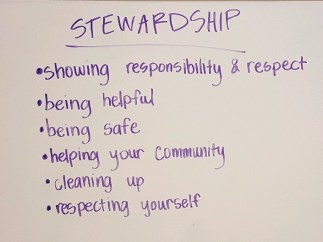
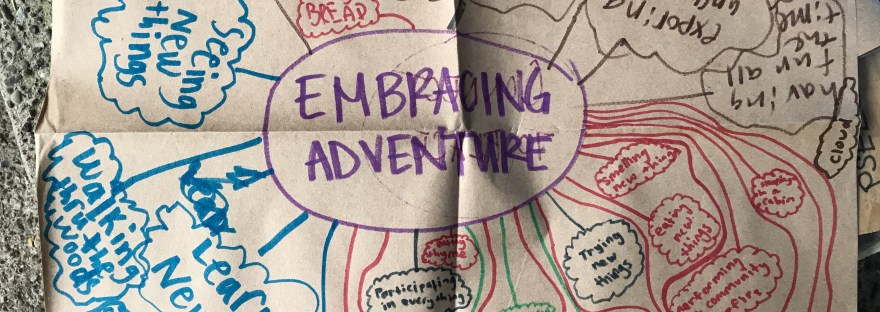
From there, we shared the idea of the four pillars of stewardship with the students, and told them the name of each, without describing what each pillar meant. We provided each group (of 2-3 students) with a piece of paper with the name of one pillar in the middle for them to mind map their ideas of what this pillar meant, things they had done so far that were a part of that pillar, and things they imagined they may do that would be a part of it. Since we had so many adults with our group (2 chaperones & 3 instructors!) we were able to float from group to group and provide them with a lot of guidance, modeling, and scaffolding to come up with ideas, as well as assess their thought process and understand where they were within their understanding of each pillar. The students all fully participated and were engaged in coming up with ideas and discussing these thoughts with their partner or group members. After they developed these mind maps, we regrouped and each group shared what they thought their pillar meant along with a couple of favorite ideas of things that might fall under that pillar. After this discussion, students completed the Path to Stewardship self-assessment, and were able to get through it more quickly than any group I had before, and many students began to fill out the questions on each page unprompted.
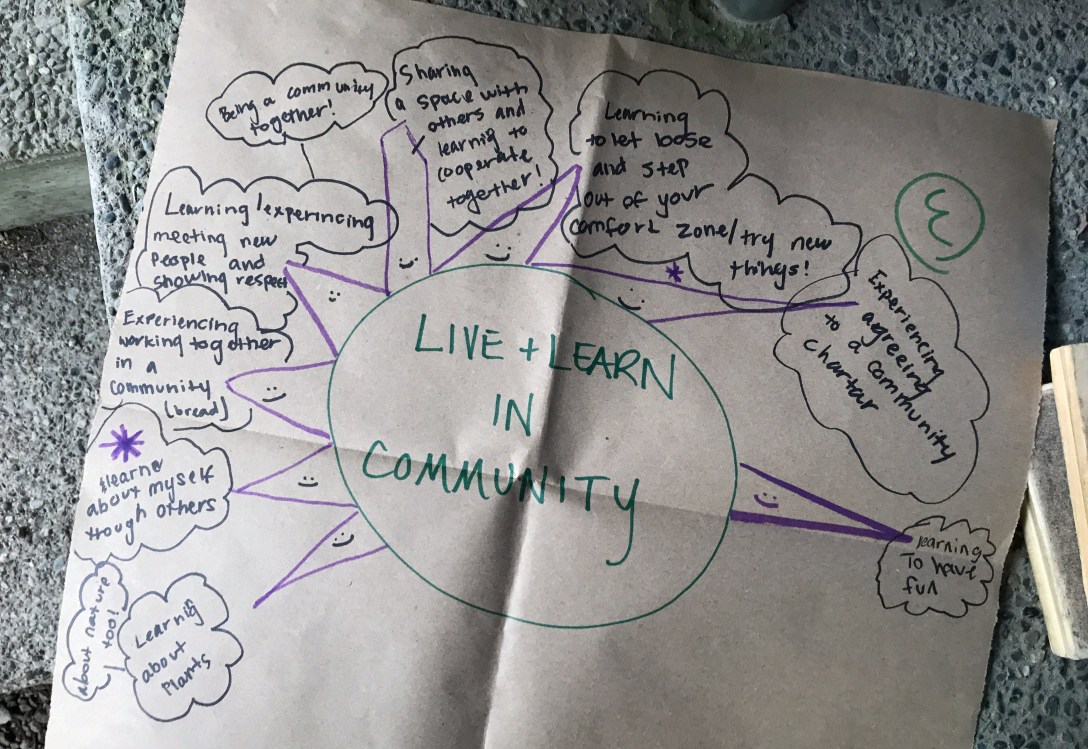
Their ideas were wonderful, and laid the foundation for the week ahead. We explained to the students that we would be focusing on 2 pillars per field day. Tuesday focused on Exploring Here & There and Helping the Environment, with activities planned like the Each One Teach One and a plant diversity investigation. Wednesday was focused on Embracing Adventure and Living & Learning in Community, with a big focus on team building challenges at the Teams Course and ending the day with a solo walk.
Students were able to articulate after any given activity how it connected to a specific pillar when prompted. Our debriefs of activities often focused on questions like, “Why do you think we chose this activity today?” For instance, after we played the game Tank & Operator on Wednesday, in our debrief discussion, most students mentioned things like practicing effective communication with a partner being key to a successful community. We could ask students about a specific pillar and they could name multiple experiences that connected with that idea. Thus, we were able to have students name the steps of each pillar and make connections between these pillars and the activities they were doing instead of us just telling them why these experiences were important.
On Thursday, we ended with a Path Map and completed our Path to Stewardship self-assessments. Students were able to more quickly identify experiences that connected with each pillar, needing only a few minutes to complete that step. Students were more thoughtful in their evidence for each pillar than I had experienced yet, writing more detail than I’d seen yet and providing different answers than the typical canned answers that many students write (like only writing “picking up trash” for helping the environment, or “working together” for living & learning in community).


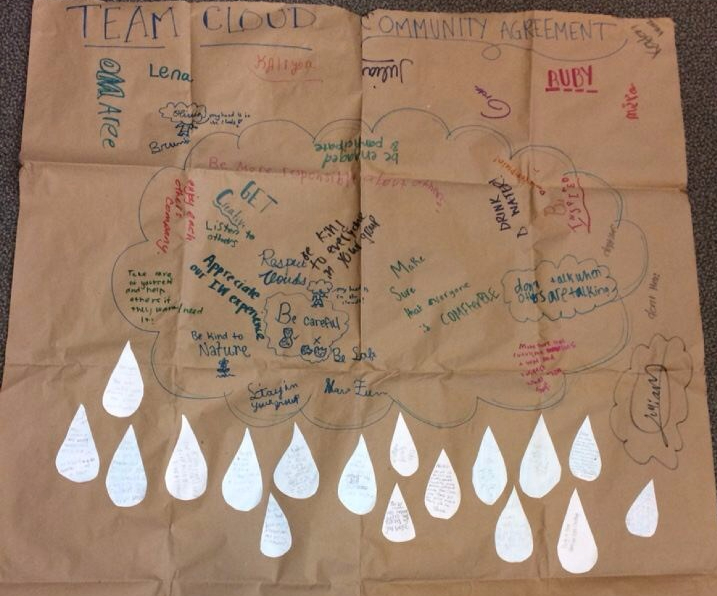
We also incorporated a bit of naming the steps in our community agreement. Students named the steps of a positive community by listing specific actions they could take to have a successful week within their community. We also incorporated an activity called “Cloud Confidential” as part of the community agreement, where we had students draw a name of another student in the group and watch that person all day to observe them doing something beneficial to our community. After we reported back on our findings at the end of the day, students wrote their observations on a raindrop which was added to our community agreement. Not only had they named the steps of the effective community, they watched for other students who were following these steps or even noticed new steps that were not part of the community agreement. We glued the raindrops on at the end of the day, and the final step was gluing plants at the bottom of the community agreement with each students’ name (not pictured), which they used to represent their favorite memory from our week together – this represented that our community’s positive actions led to them being able to have a positive experience together during their week at IslandWood.
Overall, the success of utilizing this method has made me feel very encouraged to use it in the future. This technique made the week feel easier and made me feel as though the students connected more with what they learned at IslandWood and had an overall more meaningful experience with a common thread of the pillars of stewardship running through each activity.
Outcomes:
Experiential Educator: Through these methods, my partner teacher and I designed connected experiences throughout the week that enhanced students’ stewardship learning and behaviors.
Knowledgeable Practitioner: By utilizing methods we learned about in our graduate program, we were able to more effectively teach our students.
Student-centered Instructor: We designed experiences based on our students’ interests and prior knowledge.
Systems Thinker: We facilitated experiences that encouraged students to examine the connections within their field group.

 Julia Tandy Harnick